| South East Asia | ATLAS of Plucked Instruments |
| •
HOME • about • collection • books • index • links • lutes • guitars early • guitars modern • mandolins • cittern • banjos • steelguitars • miscellaneous • Europe West • Europe East • Europe South • Africa • Middle East • Central Asia • India • Far East • S.E. Asia • America N • America C • America S
|
South East Asia For the area of South East Asia we regard here the countries of Cambodia, Thailand, Malaysia, Indonesia and Philippines. For Vietnam see page Far East. For Oceania (Hawaii
and Tahiti) see page North
America.
|

| top | Thailand | |||||||||||||||||||||
|
jakhay
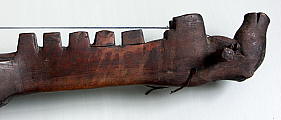
The jakhay is an instrument that is also used in other countries of South East Asia. Alternative spellings are jakae or jakhae. In Cambodia it is usually called takhe, or charakhe or krapeu. In Burma it is called mi-gyaung. Originally it was carved to resemble a crocodile, now it is more a stylized panhandle. The jakhay is made from one huge piece of hardwood, carved in the right shape and the back/bottom hollowed out. The bottom (the soundboard) is made from a softer wood, and has (roughly drilled) soundholes in it. It has 3 rounded short legs screwed into the soundboard.
|
|||||||||||||||||||||
| top | ||||||||||||||||||||||
|
grajappi
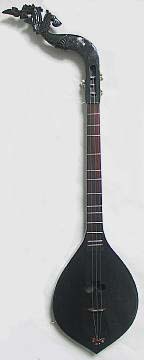
In Thailand they use a similar long plucked instrument
as the chapey dan veng in Cambodia : in Thailand it is called
grajappi or krajappii or krachappi. There
is an old and a new version. The neck and long pegbox are made from one piece of wood and glued to the body wiith a dovel join. The pegbox extents in a very long (flat) curve to the back; this bit can be taken off, and is highly decorated with dark wood and white (ivory looking) plastic. The 13 frets (in a regular seven-to-an-octave scale) are pieces of white plastic, glued to the flat front of the neck.
The strings are probably tuned : FF BB. |
|||||||||||||||||||||
| top | ||||||||||||||||||||||
|
sueng
The sueng (also spelled sung, or soung or serng or seung) is a plucked instrument that vaguely resembles the yueh qin ("moon guitar") from China. The sueung is made from one piece of hardwood,
including neck and pegbox. The body is hollowed out and covered with
another (round) piece of hardwood, with a small soundhole in the middle. It has 2 double metal strings (the old ones often made
of bicycle brake wire). They run over a loose wooden bridge to pins
at the end of the body.
|
|||||||||||||||||||||
| top | ||||||||||||||||||||||
|
sung
lisu / subu
|
|||||||||||||||||||||
| top | ||||||||||||||||||||||
|
phin
An apparently rather new type of instrument, used in
modern Thai music groups, the phin is a guitar-like instrument,
based on the Thai sueng.
The phin is played with a plectrum and the sound
is like a simple guitar (often amplified).
|
|||||||||||||||||||||
| top | ||||||||||||||||||||||
|
phin
pia The phin pia (also written
: phin phia) is a very old instrument, and is mainly used in
North Thailand. Nowadays there is only a very limited number of people
able to play it, although recently there is a kind of revival and it
is still made. The phin pia exists mainly of a straight and tapering round piece of wood, with on the thin end of this stick a bended bronze tool to fix the strings to. Usually this has the shape of an elephant head.
When the phin pia is played the open side of
the gourd is held against the players (bare) chest and by moving it
up and down the timbre of the tone can be regulated. The thin end of
the stick is hold by the right hand. Plucking the strings seems difficult,
as you have to play harmonics and open strings with both hands. |
|||||||||||||||||||||
| top | Cambodia | |||||||||||||||||||||
|
chapey
In Cambodia we can find two plucked string instruments : the chapey and the takhe. The takhe is very similar to the Thai jakhay, so see Thailand. The chapey dan veng (also chapay veng) is a (very) long neck lute. It is the same instrument that is called grajappi in Thailand. The body is made from a thick piece of wood, hollowed out, with a thin plank on top as soundboard. That body shape is supposed to be a slice of the bodhi tree or of a pineapple. There is no soundhole. The neck and the long pegbox are made from one piece of wood and glued to the body. The pegbox extents in a very long (flat) curve to the back. The frets are pieces of hardwood glued with some black wax to the neck. The pegs, which are long and round, are on both sides of the open pegbox. There are two courses of nylon strings, which can be single, or double or only one double. They run to a string holder which also serves as bridge. The strings are tuned F B. Playing is with a plectrum, mainly to accompany singing.
For more info see soundsofankor. |
|||||||||||||||||||||
| top | Malaysia | |||||||||||||||||||||
|
gambus (Johor) As in most Islamic countries, the Arabian oud is
also played in Malaysia and Indonesia. This oud is quite similar
to the one used in the Middle
East, as it came with Arab workers from Yemen (town of Hadramaut),
who carried on their tradition of playing the oud. The oud-like gambus is often
imported from the Middle East, but quite a few are locally made in Malaysia
or Indonesia. Usually they try to imitate the general shape of the imported
oud, but others have a few differences. Often the wood used
for the front is not pine wood, and certainly not bookmatched. The number of strings may vary, but the tuning and technique of playing the gambus is the same as for the oud (with a long plectrum); here more to accompany arabic singing - often in "orkes gambus". |




| top | ||||||||||||||||||||||
|
gambus melayu (skin front) Besides the oud-like gambus (see above) in Malaysia (especially on Sabah), and on some islands of Indonesia - like Sumatra, Kalimantan and Lombok (see Indonesia) - there is a another type of gambus, which looks quite different. This gambus (gambus Hijaz or gambus melayu or gambus seludang) is closely related to the old qanbus of Yemen and East Africa (see Africa). This traditional gambus
has a (narrow) body, neck and head carved from a single piece of (jackfruit)
wood. The body always has a long and large
pin-like extention at the bottom (part of the body). The
body and neck is hollowed out from the front and the cavity in the neck
covered with a thin piece of wood. The body cavity is covered with (goat)
skin. In some areas thin wood is used instead of skin (see under). The
edge of the skin is glued, but often also nailed down and decorated
with a colourful strip of fabric. This gambus melayu is played with a long plectrum, and used for vocal accompaniment of Zapin music. It has a sound similar to the oud but with a more resonant, almost hollow sound.
|
|||||||||||||||||||||
| top | ||||||||||||||||||||||
|
gambus melayu (wooden front) In Malaysia (especially on Sabah) and in Brunei, and on some islands of Indonesia, like Kalimantan and Lombok (see Indonesia) - the gambus melayu is covered with a thin wooden front instead of with skin. This gambus is made just like the skin covered gambus from one piece of wood, with a hollowed neck and body. The wooden front is less breakable, and it gives a sharper sound. Especially in Brunei the front may be painted with colourfull decorations. There is nowadays quite a cross-over between the oud-like
gambus (johor) and the gambus melayu, so that the
gambus Melayu may also be made from staves, and have 6 double strings
and a large single rosette - or three. Also the tuninghead may be bent
back (like an oud), or with a decorated carving. It may even
have tuning machines. It is played with a long plectrum, and used for vocal accompaniment of Zapin music. It has a sound similar to the oud.
|
|||||||||||||||||||||
| top | ||||||||||||||||||||||
|
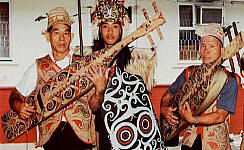
sape
The sape (or sapeh or sapeq or sapek) is one of the largest plucked stringed instruments in the world. It is mainly used on the island of Borneo (half of which is Malaysia : Sabah and Sarawak, and half is Indonesia : Kalimantan; plus the small independent state of Brunei). The sape is probably made by shipbuilders as
the body resembles very much a ship (however the hollowed out bit is
on the back...). Maybe that is why this type of instrument is known
as "boatlute".
The number of metal strings may vary from 3 to 5 and can be tuned with round wooden pegs from both sides of the peghead. Each string is the same gauge and has its own small bamboo bridge, giving each a different string length. They run over a flat bamboo bridge and go through holes to the back of the instrument. Only the first string has (flat bamboo) frets in a diatonic scale.
|
|||||||||||||||||||||
| top | ||||||||||||||||||||||
|
sundatang
This long necked strummed lute is quite rare, and found amongst the Dusunic people of Sabah (the north part of the island Borneo). The instrument looks very similar to the kudyapi boat-lutes of the Palawan from the (nearby) Philippines (see under). The sundatang is mainly made of jackfruit wood, with two (or 3) brass strings; nowadays steel guitar strings. It is made from one large piece of wood, with the somewhat oval-shaped body hollowed out from the back and covered with a separate wooden "lid". There are just a few (about 6) high wooden frets on the long neck, near the body (like on the Vietnamese Dan Day). They are only under the first string, and have a small strip of brass as proper fret.The lowest fret is the zero fret, and a small piece of cotton pulls the string down on it. The second string cannot be fretted, and is always played open as a drone. The sundatang of the KadazanDusun tribe from Penampang district, the Lotud-Dusun tribe (who call it “gagayan”) and those of the Rungus tribe are more widely played than the one of the KadazanDusuns of Tambunan district. This Tambunan sundatang has a small body and a neck over a meter long. The sundatang can be played for personal entertainment or as a dance accompaniment (in the Tambunan district - the Magarang) and is sometimes played in pairs, as in Tuaran district.
|
|||||||||||||||||||||
| top | Indonesia | |||||||||||||||||||||
Note that in Indonesia you may also find instruments described under Malaysia - like the gitar gambus (the oud), the gambus Melayu (most regions have developed their own typical model) and the sape (on Borneo).
|
||||||||||||||||||||||
|
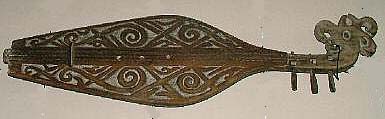
hasapi The hasapi (or kecapi) Batak is a small boat lute from the Toba Bataks (Samosir island in Lake Toba), in North Sumatra. They used to be made mainly as woodcarving souvenirs for tourists. Nowadays they are getting popular again, but in a modern version. The traditional hasapi is made from one single piece of wood, in a slender boat-shape. The body is hollowed from the front, with a small open slit on the back. The front is covered with a thin piece of wood on which a small raised left-over square bit of wood is the bridge. There are 2 metal strings, which can be tuned by round wooden friction pegs on both sides of the open pegbox. The bridge is a raised square bit of wood left in the middle of the body, to which the strings are fastened. Usually the top of the pegbox, and the end of the body
(which raises high up) are nicely decorated with woodcarvings. If the
front is left plain it may be a playable instrument; if it is over-decorated
with woodcarvings it is really hard to play. Playing is with a plectrum, mainly to accompany singing or flute music.
The example of a traditional instrument is painted in
some dark brown colour, probably with shoe polish. |
|||||||||||||||||||||
| top | ||||||||||||||||||||||
|
kulcapi karo The kulcapi is a small boat lute from the Karo Batak people of North Sumatra.
The front is covered with a thin piece of wood, with
the square bridge left as a block when the front was thinned. The neck
has a number (about 7) of metal frets, inlaid in the front in a diatonic
scale. Usually the top of the pegbox, and the end of the body (which
bends back, not up like the hasapi) are decorated with stylised
woodcarvings. The 2 metal strings can be tuned by round wooden friction pegs on both sides of the pegbox, but modern instruments may have tuning machines (one on each side). The strings are fastened to holes in the raised bridge. Playing the kulcapi is with a plectrum (often fixed with a rope), mainly to accompany singing.
|
|||||||||||||||||||||
| top | ||||||||||||||||||||||
|
gambus selodang This is the gambus melayu (or gambus seludang) used in the province of Riau, on the northeast coast of Sumatra (near Singapore), which has the local name : gambus selodang. It is quite similar to the instruments of Malaysia (see above), but here it always has a skin front. This traditional gambus has an often rather wide body, with the body, neck and head carved from a single piece of jackfruit wood, including the extention at the bottom. The top half of the hollowed out front is covered with a thin piece of wood (often ending straight - and sometimes rounded, depending on the maker), which usually has some kind of decorative soundhole. The lower half is covered with a (goat) skin, glued to the edge of the body. Often it is also nailed, with a decorative strip of fabric.
It is played with a plectrum, to accompany singing - usually together with two small drums (called "maruas"). For much more information about all the different types of gambus instruments see : Portfolio. |
|||||||||||||||||||||
| top | ||||||||||||||||||||||
|
dambus The dambus is a type of gambus melayu that is used on the island of Bangka, off the northeast coast of Sumatra. It is quite similar to the instruments of Malaysia (see above), but the dambus always has a tuning head carved like the head of a deer. This traditional dambus has the body, neck and tuninghead carved from a single piece of soft wood (sengon), including the extention at the bottom. The front of the hollowed out body and neck is covered with a thin piece of wood. The soundholes are often in a decorative pattern. Some makers like decorating the front and neck with abstract paintings. Sometimes a strip of fabric is nailed around the edge of the body.
The dambus has seven nylon (guitar)strings in 4 courses (the bass string is single). The strings run over a large loose wooden bridge, and are fixed to a round hole in the extention at the end of the body. Tuning could be f cc gg d'd' . It is played with a plectrum, to accompany singing.
For much more information about all the different types of gambus instruments see : Portfolio. |
|||||||||||||||||||||
| top | ||||||||||||||||||||||
|
(gitar) gambus As in most Islamic countries, the Arabian oud is also played in Indonesia and Malaysia (see also above). This oud is quite similar to the oud used in the Middle East, as it came with Arab workers from Yemen (town of Hadramaut), who carried on their tradition of playing the oud. In Indonesia this oud is often called : gitar gambus and mainly used on Sumatra and Java.
Although the neck is always fretless
(like the oud), sometimes the gitar gambus has painted
or inlay "frets". The tuning and technique of playing the gitar gambus is the same as for the oud (with a long plectrum), but here more to accompany arabic singing - often in "orkes gambus". |
|||||||||||||||||||||
| top | ||||||||||||||||||||||
|
kecapi dayak The island of Borneo is devided between Malaysia (Sabah and Sarawak) and Indonesia (Kalimantan); plus the small independent state of Brunei. In Kalimantan you can find the large sape (see Malaysia), but there is also a smaller plucked instrument in use : the kecapi dayak (or kecapi Borneo or kecapi Kalimantan or kecapi Kalteng), which resembles a sape but has a long fretless neck.
The fretless neck is straight and long, with the top
half (with the tuning head) usually joined halfway with a V-join to
the body. The head often has a (carved) decoration of a hornbill bird,
or some tribal carving. Usually there are 3 strings, which can be tuned
with friction pegs - or nowadays with tuning machines. The
3 nylon strings (all of the same thickness) run over a loose wooden
bridge, and are fixed to small holes in the end of the body.
Note that some sape can be smaller than some large kecapi - the main difference is the long neck and the lack of frets on the kecapi ! |
|||||||||||||||||||||
| top | ||||||||||||||||||||||
|
gambus panting Another plucked instrument found in Kalimantan (Borneo Island) is the gambus panting - also a type of gambus melayu. It is quite similar to the instruments of Malaysia (see above). The shape is not very fixed, as there are bodies with a wooden front and others with a skin front. Also the head with the tuning pegs may have different shapes, sometimes with elaborate wood carvings, and even facing sideways. The traditional gambus panting has the body, neck and tuninghead carved from a single piece of wood, including the extention at the bottom. The front of the hollowed out body and neck is covered with a thin piece of wood (or sometimes skin for the lower part). The soundholes in the wooden front are often in a decorative pattern. The neck is fretless. The peg head slants to the back, with the end curling to the front (like the gambus selodang). It has 8 friction pegs (4 on each side) on the sides of the open tuning head. Some makers put the pegs on a row on the right side (4 from the back, 4 from the front), with fancy woodcarvings.
The gambus panting has 8 nylon (guitar)strings in 4 courses. The strings run over a loose wooden bridge, and are fixed to holes in the extention at the end of the body. Tuning could be ff cc gg d'd' . The gambus panting is played with a plectrum, and used in a small orchestra (also called "panting") to accompany singing : "musik panting" and in Panting Banjar music. For much more information about all the different types of gambus instruments see : Portfolio. |
|||||||||||||||||||||
| top | ||||||||||||||||||||||
|
gambus lombok This is a special gambus from the island Lombok used for "cilokaq" music from the area of Sakra. Also called gambo. This large gambus is entirely carved
from one piece of wood, with a small soundhole on the back of the body.
The front of the cavity of the body is covered with a thick wooden panel
(more than 1cm), with a sound hole in it (often not round).
The strings run over a large loose wooden bridge to 4 holes in the extension at the bottom of the body, and tied to a small stick. This gambus is usually played with a plectrum,
to accompany singing in a "cilokaq" ensemble. For more information about gambus lutes from Lombok, see : Portfolio06. |
|||||||||||||||||||||
| top | ||||||||||||||||||||||
|
kecapi makassar (Sulawesi) This is a special boat lute from the island Sulawesi (formerly : Celebes). It is called kecapi [pronounced "kechapi"] makassar, but also : kecapi bugis, kacaping or katapi. A quite similar, but wider instrument is found on Sumba, called jungga (see under). The kecapi makassar is traditionally made from one piece of wood, with a cavity on the back. This is covered with a separate wooden panel, with several round sound holes in it. Modern kecapi may be made from separate pieces of wood, glued together. The peghead has usually a highly decorated panel, also carved from the same piece of wood. Nowadays on modern kecapi these panels are made from separate wood, and often left plain.
The kecapi has two metal strings, tuned by small friction pegs. The strings are pressed down on a row of 5 or 6 high finger posts, carved integrally from the neck and soundboard. The bridge is a similar high post. Modern ones have a small piece of brass on each post as a "fret". It is strummed with a long thin plectrum, for solo music or to accompany songs.
|
|||||||||||||||||||||
| top | ||||||||||||||||||||||
|
jungga This is the two-stringed jungga from the island
of Sumba. It looks quite similar to the kacapi
from Sulawesi, only not so narrow.
The two rope strings are in fact one string that goes around the bridge. They can be tuned with two friction pegs on both sides of the head. The tuning head ends in a simpel woodcarving of an animal. The jungga is played with a plectrum (with one string as drone), mainly to accompany songs. |
|||||||||||||||||||||
| top | ||||||||||||||||||||||
|
benyol On the island Flores they use a small instrument called a benyol, or benyol maumere.
The neck is fretless, and flush with the front. It has a flat tuning head, usually with guitar machine tuners. The 4 nylon strings run over a loose bridge to some pins at the end of the body. The tuning is not clear.
|
|||||||||||||||||||||
| top | ||||||||||||||||||||||
|
bijol On Timor island they use a four-stringed, locally made guitar. The general name is bijol, but it has also several different local names, like bijola, benyol, leku, leko boko, letes, pisu, kasi, raraun, sbo biol makosu, or juk timor etc. The bijol is completely carved from one piece
of hard wood, with only the body hollowed out. The body can be oval
shaped, round or in the shape of a small guitar. The tuning head is flat, with four friction pegs from the back. The four nylon fishline strings (all of similar thickness) run to the bridge on the front and are tied to a small wood strip at the back of it. Some instruments may have a loose bridge and then the strings are fixed to a stringholder at the bottom of the body. The instrument is left unvarnished and has no decoration.
|
|||||||||||||||||||||
| top | ||||||||||||||||||||||
|
keroncong guitar / cak / cuk The keroncong guitar is a small ukulele-type guitar from Java island, mainly used in Keroncong music (pronounced "kron-tjong"), which has some Portuguese influence (from the late 19th century).
Both instruments have a raised fingerboard with metal frets. The tuninghead is always flat, with machine tuners from behind. The strings run over a loose bridge to a mandolin-like stringholder. The body and neck are varnished in colour, the soundboard is varnished or painted (sun-burst). The cak is played in 4-beat, with the off-beat strums accentuated; the cuk plays usually arpeggios. Together the cak and cuk form a set with interlocking strums, that gives Keroncong music its characteristic rhythmic sound. The other instruments used in traditional Keroncong (or Kroncong or Krontjong) music are usually the gitar tunggal - (the guitar of local or of western manufacture), the violin, the flute and often a (plucked) cello and a (plucked) contra bass. However, Keroncong music can also be performed using modern instruments like electric guitars, electronic keyboards and a drumkit. This music is also very popular among the Indonesians living in Holland. |









| top | Philippines | ||||||||||||||||||||
|
bandurria
The laud, the bandurria and the spanish
guitar are the instruments used in Spanish Rondalla music, and
as the Spanish ruled the Philippine islands for three centuries, this
type of music became also popular on the Philippines - and even with
Philippinos now living in the USA. The Philippine instruments look quite similar to the Spanish bandurria and laud (see Europe west), although the number of strings has increased. From 12 strings in 6x2 courses in Spain, to 14 strings in 6 courses in the Philippines : 6th single, 5th and 4th double, 3th, 2nd and 1st three double. The bandurria (sometimes spelt : banduria, or called banduria guitar) is made like a flat back mandolin. The soundhole is usually round like on a guitar. The tuning head is made like a slotted guitar-head, or flat, with machines from behind - seven on each side. It has a raised fingerboard.
Playing the bandurria is with a plectrum, often with a mandolin-like tremolo. |
||||||||||||||||||||
| top | |||||||||||||||||||||
|
laud
The Philippine instruments like the laud and the bandurria used in the Rondalla music look quite similar to the original Spanish banduria and laud (see Europe west).
|
||||||||||||||||||||
| top | |||||||||||||||||||||
|
octavina
The laud, the bandurria and the spanish guitar are the instruments used in Philippine Rondalla music, with sometimes another instrument : the octavina. The octavina is a special Philippine instrument
: it is a guitar-shaped laud, so it has 14 metal strings in
6 courses : 6th single, 5th and 4th double, 3th, 2nd and 1st three double.
Playing the octavina is with a plectrum, often with a mandolin-like tremolo.
It is not very clear where the name octavina arrived from - as the name is also used for a small spinet (plucked 17th century keyboard). However, in Spain used to be a small guitar-like bandurria instrument with 6 double strings, called octavilla; very likely that is the origin of the name.
The black colour of the front of the example is just painted on; others were red or plain. |
||||||||||||||||||||
| top | |||||||||||||||||||||
|
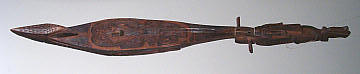
kudlung
/ kudyapi / hagelung
On the Philippines the long boat-lute with two strings is still quite popular in some areas. It exists under many different names, although they all look quite similar : kudlung, fagelung, hegalong, hagelung, kudyapi, kutyapi, kusyapi, ketiyapi, etc. It is mainly called kudlung in the south and kudyapi in the north. For the kudyapi used by the Palawan tribe see under. Like all other boat-lutes, the entire instrument (with all additions, except tuning pegs and frets) is carved from one piece of (soft)wood, with the resonator chamber carved from the back, and covered with a thin wooden board, sometimes with a soundhole in it. The sides of the body and neck form a long flowing bulge. The front and the back are flat. The length of the instrument can be from about 1 to even 2 meters. Some instruments are highly decorated and painted.
It is usually played with a small wooden pick, bound to the forefinger. Only the first string is fingered, the second string is only a drone. It is mainly played solo or to accompany singing or dancing. For lots of information see Brandeis and Kipas.
|
||||||||||||||||||||
| top | |||||||||||||||||||||
|
kudyapi
The kudyapi boat-lute used by the Palawan tribe looks very similar to the sundatang from Borneo (see Malaysia), but bigger. Like all other boat-lutes, the entire body and
neck is carved from one piece of (hard)wood, with the resonator chamber
carved from the back, and covered with a separate thin wooden board
(sometimes with some soundholes in it). The body shape is bulging on
both sides, with a straight top and bottom. The front and back are flat.
The length of the instrument can be from about 1 to far over 2 meters.
The kudyapi is usually played with a small wooden pick, bound to the forefinger. Only the first string is fingered, the second string is just a drone. It is mainly played solo or to accompany singing or dancing. For lots of information about Philippine boat-lutes see Brandeis and Kipas. |
||||||||||||||||||||
| top | |||||||||||||||||||||
|
kitara
Primitive guitar from the Philippines. It is made like a normal guitar, with no (or just a few) frets and played like the player thinks it should be played. Usually used by young kids.
|
||||||||||||||||||||
|


