| miscellaneous | ATLAS of Plucked Instruments |
| •
HOME • about • collection • books • index • links • lutes • guitars early • guitars modern • mandolins • cittern • banjos • steelguitars • miscellaneous • Europe West • Europe East • Europe South • Africa • Middle East • Central Asia • India • Far East • S.E. Asia • America N • America C • America S
|
miscellaneous Here I have put all the instruments that I found difficult
to put on any of the other pages, but which still can be regarded
as plucked instruments in one way or another.
|
|
multiple
neck guitar Sometimes guitar players like to have 2 instruments in one, so they can quite quickly change instruments. Makers came up with the idea of putting 2 different necks on a body. Combinations can be of a normal 6-string neck with a 12-string neck, or with a bass-neck, or with a mandolin-neck, etc. For very strong players (these instruments are very heavy) triple and even quadruple necks are made, with any combination mentioned above, or (see picture) including a 7-string neck.
|
|||||||||||||||||
| top | ||||||||||||||||||
|
multi-stringed
guitar Already in the 18th century guitars were made with more than 6 strings, but that were often harp guitars, where the extra strings can only be played open, as they run from a separate neck, and not over the fingerboard. Multi-stringed guitars are having all the strings
running over the fingerboard and all strings can be fingered. The most
popular type used nowadays are 7-string guitars (both classical
and electric), with special versions like the Russian guitar
and the Brazilian violão de sete cordas (see elsewhere
in ATLAS). It was probably the guitarmaker Lacote who developed
special multi-stringed guitars, although most of them were
harp guitars. The ten-string version was called decacorde
- "ten strings" - (see harpguitars.net),
and Carulli even wrote a study book for it. Tuning for his decacorde
was C D E F G A d g b e'. Narciso Yepes had in the 1960s a 10-string guitar
built (now based on modern guitar making techniques), with the
intention that the 4 extra strings would give more resonance from the
overtones of the (free) bass strings. For more information about the 10-string guitar
see :
Decacorde, or Tenstringguitar.com.
|
|||||||||||||||||
| top | ||||||||||||||||||
|
fretless
guitar In fact any type of guitar can be fretless, if there are no frets on the fretboard. Already for decades bass guitars (both electric
and acoustic) were available in fretless versions. Now also normal guitars
with fretless necks are becoming popular, mainly to give the music a
kind of Oriental (or better : Middle Eastern) sound. For some more detailed information see Fretlessguitar.
|
|||||||||||||||||
| top | ||||||||||||||||||
|
guitalele
A guitar, with the size of a tenor ukulele (see America north), hence the name. Sometimes also called guitarlele, or 6-string ukulele. Usually the guitalele looks like a small guitar (with guitar-like tuninghead and machines), not like a standard ukulele. Although it may look like a toy childrens' guitar, it is a proper playable instrument. Yamaha makes a cheap version, but most ukulele brands can provide an upmarket version. The six nylon strings are tuned 5 frets up from a normal
classical guitar :
|
|||||||||||||||||
| top | ||||||||||||||||||
|
Gittler
guitar This instrument ranks as the most minimal guitar. It was designed and made in the 1970's by Allan Gittler. It is just a round metal pole as body/neck, with press-fitted
round metal frets and bridge. No wood is used for the instrument. For more information see Vintageguitar, for an interview with Alan Gittler.
|
|||||||||||||||||
| top | ||||||||||||||||||
|
guitar synthesizer / digital guitar
In the 1970's in the wake of electronic organs a guitar-shaped synthesizer was developed. It is also called digital guitar, or midi-guitar. Although a digital guitar has more or less the
look and feel of a real (electric) guitar, the sound is not
at all produced by the strings, or with pickups. In fact by putting
the finger on the string/fret position and plucking the string give
the electric sensors the signal which pitch you want it to sound. This
sound is then electronically produced. Usually you can choose (like
on an electronic organ) between far ranging tone colours as
"acoustic guitar", "banjo", "sitar", "clarinet",
or even "hammond organ". Most guitar synthesizers include a percussion section, and some (like the popular Casio DG) even have a build-in amplifier and speaker. You can play the instrument like a normal guitar
: with a plectrum or fingerpicking. However effects like string-bending
do not work. |
|||||||||||||||||
| top | ||||||||||||||||||
|
nano
guitar The world's smallest guitar is 10 micrometers long (about the size of a single human blood cell) with six strings, each about 50 nanometers (or 100 atoms) wide. Researchers made this nano guitar in 1997 for fun at the Cornell Nanofabrication Facility, where they carved it out of crystalline silicon, to illustrate the new technology for nanosized electromechanical devices. The nano guitar has six strings; each string is about 50 nanometers wide, the width of about 100 atoms. If plucked (by an atomic force microscope, for example) the strings would resonate, but at inaudible frequencies. See for more information : Cornell.
|
|||||||||||||||||
| top | ||||||||||||||||||
|
air
guitar The early history of the air guitar is still shrouded in mystery, but apparently similar instruments can be found all over the world, also in many non-western societies. Air guitars are made with imagination and come in any size, shape and colour, with amateurs sometimes using umbrellas, rulers and hockey sticks as a substitute for the real thing. Fretted versions are rare. Although the air guitar could be acoustic, the electric models are the ones most widely used, mainly because Rock&Roll and Heavy Metal are the most popular music styles. Air guitars are quite cheap and nowadays there is even a trade in second hand instruments on eBay. A lucky bidder may get a very rare instrument, "as good as new, used only for 20 minutes during the Rolling Stones London Concert of 1998". Playing the air guitar is usually based more
on imitating and exaggerating the movements of the intended guitar hero
than of their musical abilities. First played only in the privacy of the bedroom
- or at most at late night (drinking) parties - now players are more
in the open and may be found performing during festivals. Since a couple
of years there are even official competitions, with a real World Championship. |
|||||||||||||||||
| top | ||||||||||||||||||
|
upright
bass Although almost every bowed stringed instrument can also be played by plucking the strings, here is only one example : the upright bass (large violin). Also called standing bass, string bass or plucked bass or something, it is the main bass instrument in many music bands, like rock&roll, jazz, and popmusic. The upright bass is slowly on replaced by the electric bass guitar, which is easier to amplify (and to transport....).
|
|||||||||||||||||
| top | ||||||||||||||||||
|
stoessel
lute This interesting instrument (also called Stössel laute) is invented in the early 1900 by Mr. Stoessel in Germany, who made them in a small factory till about 1940. This instrument is very peculiar as the way of playing is not in the normal way of fingering around the neck, but by pressing down the strings from the top / back. Many different models were made, also with different numbers of strings. As you could not "move up the neck" there were only 5 frets (plus zero fret). Some instruments (like the example) have slanting frets and bridge. The back is slightly rounded. The stoessel lute is not a very loud instrument. See more about the instrument on this interesting website: Miner Stoessel Lute.
|
|||||||||||||||||
| top | ||||||||||||||||||
|
cigar box guitar For centuries, poor people who wanted to make music,
used available scrap materials to make their own home-made imitations
of the expensive luthier-made proper instruments. Their main problem
was/is usually making the soundbox – often ending up with a kind
of square box. At the end of the 19th century nice wooden cigar boxes
of different sizes became available. This gave people an easy start
to use them as body for their home-made instruments. By just adding
a piece of wood (as neck) to the box and putting some strings on it,
everyone could quite easily make their own instrument : violins,
mandolins, ukuleles, banjos, dulcimers or
guitars. Besides wooden cigar boxes, also metal boxes (for candy or biscuits) and even oil cans are used in a similar fashion for making a body. Worldwide similar constructions can be found : in Africa – where lots of articles are made from scrap materials - the ramkie is a guitar made from an old oil can (see Africa). In Japan just after the War the sanshin was made using empty milk tins as body (kankara sanshin – see Japan). In other countries a calabash, a coconut or even the back of a tortoise or an armadillo would be used as a base for the soundbox. As the sides of a cigar box (or candy box) are too thin
and too weak for the large forces of the strings at the neck join, the
neck often goes through the entire body, so the end of the wood sticks
out of the other end of the box. Electric instruments will even have
the entire box filled with wood, for sustain. The neck itself will be
home-made, or scavenced from a real instrument - to get a good playable
instrument. It can be left without frets (to play bottle-neck or slide-guitar),
or fretted like a dulcimer or like a guitar. Tuning and playing depends of course on the instrument type and on the player : often a kind of Delta Blues with a bottle neck or picking/strumming folky music. For more information about cigar box guitars and other similar instruments, see : CigarBoxGuitars, or CigarBoxNation.
|
|||||||||||||||||
| top | ||||||||||||||||||
|
tea
chest bass The tea chest bass is a home made bass used in acoustic skiffle and folk music. Traditionally made from a (empty) wooden tea chest, a broomstick and a suitable piece of rope. The rope (with a knot underneath) goes through a hole in the top of the chest and is tightly fixed to the top of the broomstick. By gripping the rope on the appropriate places you can more or less play a very "dark" bass line. One reason why the tea chest bass is not so popular anymore, is because the tea trade has already long ago replaced the wooden chests by plastic crates and boxes. Instead of a tea chest some people use a metal washtub.
|
|||||||||||||||||
| top | ||||||||||||||||||
|
strumstick
This is a quite recent designed folk instrument (by Bob McNally), as a combination of a simple guitar-like instrument and a dulcimer. It vaguely resembles a Turkish saz. Some people call it a stick dulcimer. With a banjo-body it will be called a dulcijo (see the banjo page) The neck is the main part of the strumstick,
and has frets in a diatonic scale, so only a very limited number of
modes can be played on it. The strumstick is played by strumming all strings (like a guitar), and usually fingering only the first string. It is very easy to play songs on it.
For more information see Strumstick.
|
|||||||||||||||||
| top | ||||||||||||||||||
|
the
Stick Emmett Chapman invented in the 1970s The Stick : a guitar without a body, just a wide flat neck/fingerboard with frets, and with 8 or 10 or 12 strings and (stereo) amplification. Chapman had discovered you could play an (electric) guitar by tapping the strings with both hands simultaneously on the fingerboard, thereby being able to create separate bass-lines and harmony-lines. So he made a long fretboard (scale is 915mm !), with extra strings, which eventually became The Stick. The Stick can only be played by tapping (hammering on) with both hands, resulting (if done by an expert) in chords, bass-lines and solo-lines, like you play on a keyboard. The Stick never really has been very popular, partly thanks to the very special playing technique (which also limits the possible types of music to be played on it) and probably partly thanks to the high price. Another similar played instrument is the "touch style guitar" produced by Warrguitar, which looks more like a normal electric guitar, although with 8 to 14 strings.
|


| top | |||||||||
|
Akkordolia
|
||||||||
| Basically
an Akkordolia is a soundbox, with a number (2x4) of strings on
top, which can be strummed on the right side. On top of the box is a complex
apparatus with buttons which can be pressed down on the strings, to shorten
them. Unlike the mentioned related instruments, the buttons on an Akkordolia
do not press down the fret itself, but (as there is a real fretboard with
frets) the push-buttons push the strings down on the frets. The bottom row of buttons is numbered 1 to 18, which includes all the notes for the first octave (nr 13) and then only the whole notes. These buttons only reach the 4 melody strings. The five buttons on the top are numbered A, B, C, D and E, and are used to shorten the 4 separate chord strings. Tuning given by Teller : F A c f / f f f f. |
|||||||||


| top | NOT INCLUDED When setting up this website ATLAS
of Plucked Instruments, I decided to limit it to the definition that
each string must be used for more pitches. |
|||||||
|
bandura This is a kind of Ukrainian zither/harp. The long strings
on the neck are the basses, plucked "open" with the left hand,
the rest of the strings are plucked with the right hand, so it looks
like a guitar-like instrument, but it is not : it is a kind
of harp.
Don't confuse the bandura with the bandurria from Spain, which is a kind of mandolin (see the page of EuropeWest). |
|||||||
| top | ||||||||
|
kora
The most wellknown string instrument of Africa is the kora. However as it is played like a harp (with all open strings), it should not be included in this website. The kora is played mainly in West Africa. It
is made from a very large gourd, with a large stick (neck) through it.
Playing the kora is by holding the instrument
with the stick (bridge) with all the strings towards the player. While
some fingers hold two vertical sticks on the top of the body, the thumb
and forefingers of both hands are free to pluck the strings.
For more information about the kora, see Kumbengo.
|
|||||||
| top | ||||||||
|
gusle
On eBay this instrument is often described as "African" lute, because of the woodcarvings on the back of the body and on the top. However it is not a plucked instrument, but bowed, as it is a Yugoslavian folk fiddle. The gusle has just one (nylon) string, and a leather front. The top has usually a carving of an animal : a horse, a goat or something. See more information at Guslee.
|
|||||||
| top | ||||||||
|
tonkori
The Ainu people in Japan use a very special instrument,
called the tonkori. It looks like a slender guitar,
but is in fact a kind of zither. The tonkori is held vertically, and the open
strings plucked with both hands, often playing arpeggios, but also strumming
all the strings together.
|
|||||||
| top | ||||||||
|
autoharp
An autoharp (sometimes also called chromaharp) is a zither, with about 20 to 36 strings, tuned in chromatic order. On one side are bars (representing chords) that can be pressed down on the strings. On the bottom of each bar are pieces of felt that block off the sound of strings which are not part of that particular chord, so leaving only a few strings able to sound, when the strings are strummed. The chords are C, F, G, G7, am, E7, em, etc. Bars of chords that usually are used together in a song, are grouped together. The autoharp is played by holding the instrument up like a small child in the arms, pressing with the left hand the bars, and strumming with the right hand most of the strings just above the bars. It is possible to play some kind of tune on it by aiming for the right top note of the chord, while strumming. As the strings are not shortened, but the sounding ones always played open, the autoharp falls not within the context of this website...
For more information about autoharps see Autoharp.com or Autoharpteacher. For all kind of zithers see : Minermusic.
|
|||||||
| top | ||||||||
|
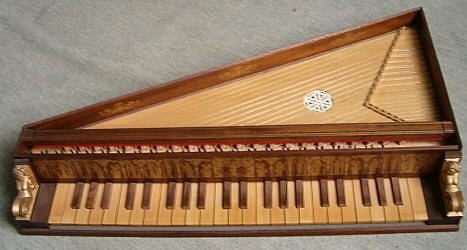
spinet
|
|||||||
|