| Europe East | ATLAS of Plucked Instruments |
| •
HOME • about • collection • books • index • links • lutes • guitars early • guitars modern • mandolins • cittern • banjos • steelguitars • miscellaneous • Europe West • Europe East • Europe South • Africa • Middle East • Central Asia • India • Far East • S.E. Asia • America N • America C • America S
|
Europe (East) Here is the second page of Europe, the East
:
|

| top | Austria | ||||||
|
concert
zither The concert zither is a typical instrument of the mountainous area of central Europe, so Austria and surroundings. Although zithers in general would not be included in this website, this one is different, as there is a fingerboard with frets to play the melody. The concert zither is basically a wooden box (although in a nice rounded shape), with on one side (like a kind of keyboard) 5 strings over a fretboard with metal frets. Next to the fretboard are about 27 more strings, which are played open. They are arranged in 7 chords of 4 strings each, which for orientation are separated by strings in a different colour. The strings over the fretboard are tuned with guitar-like tuning machines; to tune the rest you need a tuning key. The two top strings are in the same pitch, but apparently not played together. To play the zither you put it in front of you on a table with the fretboard towards you. The right hand picks with a metal thumbpick the melody strings, and with the index or ring finger you strum the chord strings, just aiming for the right chord group. The left hand pushes down the strings on the fretboard. As the highest string is nearest the player, the playing is just the other way around from playing guitar. Usually just folk music is played on it, and due to the
soft sound - mainly only at home. |

| top | |||||||||||||||||||||
|
schrammel
gitarre The schrammel gitarre is a special harp guitar used in so called "schrammel quartets" in Wien (Vienna), with violin, viola and clarinet to play semi-classical music in restaurants. It is called after the two brothers Schrammel who made this type of music popular in the 19th century. The schrammel guitar (also called kontra-gitarre) provides the harmony and the basses for the music. Nowadays often only a harmonica and schrammel gitarre are used. The schrammel guitar can have many shapes, but basically it is a large spanish guitar (with 6 nylon strings), with an extra unfretted neck, with 3 to 9 extra bass strings, which are only played open. The peghead can be different (some look like Fender guitars), with some having a separate nut for each string, giving extra string length. To withstand the enormous pull of the strings on the body, there is a steel pin inside. To get some orientation in the bundle of bass strings, some are coloured red. Tuning is like a normal guitar, with the bass strings often in decending order. Playing is like a normal classical guitar, mainly in chords, with the thumb picking the occasional bass string (like on the baroque lute).
For a look at very many types of schrammel gitarre see Harpguitars.net - it will be under form 2c; don't drown in all the hundreds of other types ! |
||||||||||||||||||||
| top | Russia | ||||||||||||||||||||
|
balalaika
The most famous Russian instrument is the triangle shaped balalaika. The shape makes it difficult to hold. It comes in several sizes, from the soprano ("primo"), alto and tenor, to the large bass balalaika in big balalaika orchestras, playing (fast) folk melodies. The balalaika is made from ribs joined together (a bit halfround) with the shape forming a triangle at the front. It has a narrow neck with a flat tuning head, with 3 tuning machines from the back. The body has a small round soundhole, and the front is either painted with some folk like decoration, or (the more professional ones) has inlayed woods in the top and lower corners. Three strings run over a loose wooden bridge to pins at the edge of the body. There are two different kinds of balalaika : the academic
one and the folk one. Playing the balalaika is either with a plectrum or strumming with the fingers. Well known are the repeated mandolin-like tremelos. Usually the two lower strings are fingered with the thumb and the melody played only on the first string.
For more information about the balalaika see : get-tuned. |
||||||||||||||||||||
| top | |||||||||||||||||||||
|
domra
(3-string version) The domra is another Russian instrument, which comes in many sizes (soprano to bass), for use in balalaika- or special domra orchestras. It also comes in two different types : one with 3 strings and tuned like a balalaika (mainly used in Russia), and one with 4 strings, tuned like a mandolin (mainly used in Ukraine, see under). Don't confuse the name with the dombra, which is a longneck lute from Kazakhstan (see Central Asia), or the dumbyra of the Bashkir (see under). The domra is made with ribs glued together in
the shape of half a football. The front is almost a circle, with over
the top half usually some extra layer as scratchplate. This is often
made of black painted wood (sometimes with white dots around the edge).
The small round soundhole has usually a rosette in a flowershape. Tuning of the 3-string domra is often e' a' d", or like a balalaika : e' e' a'. Playing is with a plectrum or strumming with the fingers, like the balalaika.
|
||||||||||||||||||||
| top | |||||||||||||||||||||
|
Russian
guitar The native Russian guitar
of the early 19th century was a 7-string instrument with an open G-major
tuning and metal strings. After a visit by Segovia to Russia, the 6-string (spanish) guitar soon replaced the Russian guitar, although the instrument remained popular with amateurs as it was easy to play basic chords.
Note that in Brazil is also a type of 7-string guitar, called violão de sete cordas (see South America). |
||||||||||||||||||||
| top | |||||||||||||||||||||
|
dumbyra
(bashkir) The Bashkir people, who live in and around the Ural mountains, use a long-neck lute with 3 strings, called dumbyra (or dombyra or dombra). This is a different instrument from the 2-string dombra used in Kazakhan (see Central Asia). The body of a dumbyra of the Bashkir is usually
made with ribs glued together in a pear shape (like the Kazakh dombra).
However some are made with flat sides and an only slightly rounded back.
The slightly raised fingerboard has metal frets in a
western scale. The 3 nylon strings run over a large loose bridge to
3 small pegs at the end of the body. Playing is with a plectrum or strumming with the fingers, a bit like the balalaika. Often it is played solo classical style, with piano accompaniment. |
||||||||||||||||||||
| top | Ukraine | ||||||||||||||||||||
| In Ukraine existed some old lute-like instruments, which all had some connection with the bandura, which is a zither/harp. These were called husli, bandura, torban and kobza. The husli was a proper zither, the oval shaped bandura (see under miscellaneous - "not included") had many strings on the front, and a neck with bass strings, that could be fingered if you wanted, but were normally played open; the torban was a theorbe lute (see page lutes) with additional short strings on the soundboard (like the bandura), and the kobza was a bandura with fewer strings, and the bass-strings on the neck were sometimes fingered. Only the bandura is nowadays still very popular, and it is even the "national instrument" of Ukraine. However in the 1970's they have tried to revive the kobza, and it is still used by folk groups. | |||||||||||||||||||||
|
kobza (unfretted) The body of this modern
kobza is more or less made like the bandura. It is
carved from solid wood, with a slightly rounded back, and a flat soundboard
on top. The shape is usually a nearly symmetrical oval, with often a
star-like soundhole. The neck is short and has a fretless fingerboard
stretching over the soundboard. To the right (the treble side) of the neck are 6 or
7 harp-like strings, fitted to the edge of the soundboard, which can
be tuned with frictions pegs (from behind). The tuning is usually : G c d g a d' / g' a' b' c" (c#") d" e". The playing of this modern kobza is with the right hand plucking (the fingers for the harp strings, and the thumb for the bass strings). The left hand fingers only the bass strings on the fretless neck. Even chords can be played. This instrument is now popular again with groups playing traditional folk music.
Note that there exists another kobza instrument in Romania/Hungary, which is a kind of lute (see under : Romania). |
||||||||||||||||||||
| top | |||||||||||||||||||||
|
kobza (fretted)
There are basically two versions : the mandolin-type
and the guitar-type.
|
||||||||||||||||||||
| top | |||||||||||||||||||||
|
domra
(4-string version) The domra of Ukraine looks similar to the domra from Russia (see above), but it has 4 strings and is tuned like a mandolin. Don't confuse the name with the dombra, which is a longneck lute from Kazakhstan (see Central Asia), or the dumbyra of the Bashkir (see above). The domra is made with ribs glued together in the shape of half a football. The front is almost a circle, with the top half usually some overlay as scratchplate made of black painted wood (sometimes with white dots around the edge). The small round soundhole has usually a rosette in a flowershape. The narrow neck has a fretboard with metal frets. The
tuning head of the 4-string domra has an open slotted peghead with an
end scroll to the front. It has 4 tuning machines, two on each side.
|
||||||||||||||||||||
| top | Romania | ||||||||||||||||||||
|
cobza / koboz In Romania exists an old lute-like instrument, which is called cobza (or kobsa, or kobza). In Hungary a similar instrument is called koboz (or coboz or kobuz). The body of the cobza is made from 5 wide ribs, glued together. It has a long teardrop shaped front, with an inlayed (square) scratchplate just above the bridge, and some star-like slits as soundholes (some have also an extra, small triangular soundhole). The bottom edge of the front of the body is protected with a strip of leather. The very short neck has no frets, and the fingerboard
is flush with the front. The open pegbox joins the neck at an almost
straight angle. The wooden friction tuning pegs are 4 on each side.
Some cobza nowadays have tuning machines. The playing is with a plectrum or strumming with the
fingers, both to accompany or to play solos. During the Sovjet period the traditional cobza was altered and fitted with a mandolin-like neck, with frets. This type of instrument (also called cobza) is still popular in Moldova (see under). Note: There existed also another instrument with the
name kobza in Ukraine, which is often a kind of harp/zither
(like the bandura), see under miscellaneous
("not included"). However sometimes the neck is fingered :
see Ukraine (earlier
on this page). |
||||||||||||||||||||
| top | |||||||||||||||||||||
|
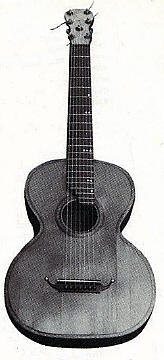
zongora
This instrument is in fact a normal guitar but
slightly altered, to use it for a special way of playing - so not really
a special instrument. Zongora musicians buy their (cheap) instrument in stores, replace some of the (steel) strings and put them close together in the middle of the neck. The zongora is played by just rhythmic strumming the strings with a plectrum. The rhythm is dictated by the melody. To change the chord from time to time the index finger of the left hand is moved up and down the neck, pressing all the strings down at the same time (like a steel on a dobro). Modern players will also use more complex chords.
|
||||||||||||||||||||
| top | Moldova | ||||||||||||||||||||
|
cobza (moldova) The unfretted Romanian cobza/koboz that was in use for folk music, was during the Sovjet period altered and fixed with a fretted neck, so it was easier to write composed music for it. This type of cobza is now mainly used in Moldova, where it is still known under the name cobza.
The neck is separate, with the fingerboard raised above the front. It has metal frets. The open pegbox joins the neck at about 45 degrees angle to the back. It has tuning machines, 4 on each side. The 4 double metal strings run first over a separate
large loose bridge, and are then fixed to a guitar-like bridge, glued
to the front. Playing this cobza is with a plectrum, to play
solos or accompany songs.
|
||||||||||||||||||||
| top | |||||||||||||||||||||
tamburas East Europe has quite a few long neck lutes; a lot of them called tambura (or tamboura). Originally they are based on instruments like the Turkish saz, or the Albanian cifteli or the sargija (see for those : Europe South). The body used to be pear-shaped, but slowly the guitar-shape is getting more popular.They exist in several versions :
|
|||||||||||||||||||||
| top |
|
||||||||||||||||||||
|
tambura
Farkaš Tamburas made with frets in the so-called "Farkaš system" are now rare, hardly anybody knows how to play them properly. They were used in tamburitza groups, so they came in all sizes.
The body of this tambura is carved from one piece of wood to a quite thin shell. Originally the body had a teardrop shape, but later they were also shaped like a small guitar (still carved from one piece of wood) . The top half of the pine front (and often a small bit on the lower end) is made from dark coloured wood, with a patterned edge.The fingerboard is just a dark veneer.
The tuning head is flat with a sideways curl to the right. The tuning machines are of the tamburitza type (see under Croatia), with a curly metal coverplate on the front (which has some resemblance with the Stauffer guitar - see guitars1). All four metal strings (in two double courses) are tuned the same. They run over a small loose bridge to two metal pins at the bottom of the body. Playing is with the fingers strumming both strings, to accompany folk singing or other stringed instruments. |
||||||||||||||||||||
|
|||||||||||||||||||||
| top | Bulgaria | ||||||||||||||||||||
|
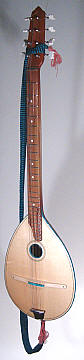
tambura
The Bulgarian tambura (or tamboura) is made in two styles : with two double strings or with four double strings. The body of this tambura is made from a hollowed
out piece of (maple) wood in teardrop shape; the body is quite shallow.
The pine soundboard is made of one piece, and slightly vaulted. It has
a round soundhole. The 4 or 8 metal strings run over a very wide loose
bridge to a metal tailpiece at end of the body. This tambura is played with a plectrum, and used to accompany (folk) singing, or to play solo music. |




| top | Macedonia | |||||||||||
|
tambura
The tambura (or tamboura) made in Macedonia looks similar to the tambura of Bulgaria, but also a bit like a Greek bouzouki (see Europe south). The body of this tambura (and the beginning of the neck) is carved from one piece of wood, but is deeper than the Bulgarian tambura. The top half of the pine front is made from dark coloured wood, with a wavy border. It has a round soundhole. The entire instrument is varnished. The neck and tuninghead are made from one piece of wood.
The fingerboard is made of different wood, and level with the soundboard.
It has metal frets. The tuning head is flat, with tuning machines from
behind - two on each side. Playing is with a plectrum, to accompany folk singing or other instruments. |
|||||||||||
| top | Croatia / Serbia | |||||||||||
|
tambura
samica / dangubica On the Balkan (in Croatia, Serbia, Slovenia) they still play a small saz-like instrument, which is called in some areas tambura samica and in others (like Lika in Serbia) it is known as dangubica. Also the name tambura kuterevka is used.
The larger instruments may have two double metal strings,
the smaller dangubica has often four single strings. Playing is usually with the finger(s), strumming all
strings together and mainly fingering only the first string(s). |
|||||||||||
| top | ||||||||||||
| Tamburitza On the Balkan (in Croatia, Serbia, Slovenia) so-called tamburitza (or tamburica) orchestras are very popular. Even emigrants in USA (or Austria) from that area still play this type of music. Basically the tamburitza is an all-string band. The different instruments are from the smallest to the biggest : bisernica, brac, bugarija, celo and berde. The body shape can be roundish (mainly only for the smallest instruments) or guitar-like for the bigger ones. Shapes and decoration can be quite different between different makers. The orchestras can be small (one of each instrument), or large with several of each (in different sizes). |
||||||||||||
|
bisernica
The smallest tamburitza instrument is
the bisernica (or prim). It plays the main melody.
Although the body shape can be different, usually is roundish. Playing is with a plectrum, with very fast passages.
|
|||||||||||
| top | ||||||||||||
|
brac
The brac is the second smallest instrument in the tamburitza orchestra, playing second melody lines. The brac (or Brach or bas-prim) is often guitar-shaped, but could also be roundish like the bisernica. The body of the brac is made like a guitar, with the top half (or an area around the round sound hole) in a different wood. The neck usually ends in a flat tuning head with a side ways scroll (like Fender guitars), and metal encased tuning machines (the metal plate is on the front, not on the back as with the Stauffer guitars). The 4 or 5 metal strings run over a loose wooden bridge
to pins at the edge of the body, with some metal covering. Usually the
first two strings are double. Playing the brac is with a plectrum, with very fast passages. |


| top | ||||||||||||
|
bugarija
The bugarija is the guitar-like instrument in the tamburitza orchestra, playing harmony/chords like a guitar. The bugarija (also called : kontra) is always guitar-shaped. The body of the bugarija is made like a guitar,
with the top half (or an area around the round sound hole) inlayed with
a different (darker) wood. The fretboard is flush with the front. The
back of the neck is varnished in a lighter colour than the rest of the
instrument. The 4 or 5 metal strings run over a loose wooden bridge
to pins at the edge of the body, with some metal (or leather) covering.
Often the first two strings are double. Playing is strumming with a plectrum.
Notice that a small sargija in Bosnia is also called bugarija (see Europe south). |
|||||||||||
| top | ||||||||||||
|
celo
/ celovic The celo (or celovic) is the guitar-like bass instrument in the tamburitza orchestra, playing bass lines/counter melodies. The celo is always guitar-shaped.
The 4 thick metal strings run over a loose wooden bridge to pins at the edge of the body, with often some covering. Tuning could be : E A d g. Playing the celo is bass runs with a thick plectrum.
|
|||||||||||
| top | ||||||||||||
|
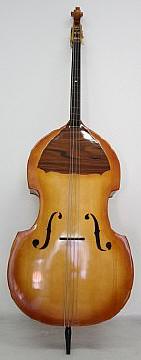
berda
The berda (or tamburaski
bas) is the string bass of the tamburitza
orchestra.
|
|||||||||||
|