| Central Asia | ATLAS of Plucked Instruments |
| •
HOME • about • collection • books • index • links • lutes • guitars early • guitars modern • mandolins • cittern • banjos • steelguitars • miscellaneous • Europe West • Europe East • Europe South • Africa • Middle East • Central Asia • India • Far East • S.E. Asia • America N • America C • America S
|
Central Asia For this website I regard "Central Asia" as the area around the mountains of North Afghanistan and India (the Pamirs, Karakoram and Himalayas) - as all the instruments in that region look remarkably similar. But although most of them are long-neck lutes - they differ quite enough to make this for instruments a very interesting region. Remember that in this area all instruments are made by local craftsmen, so there is a wide variety between makers and you may encounter quite some differences from the descriptions given here. Also the spelling of names is often slightly different. As the different peoples (tribes) in this area are living in mixed groups, do also not take the official borders very sharply. For some background information about this area see : Advantour. Click here to hop straight to : Uzbekistan, Kyrgyzstan, Kazakhstan, Tajikistan, Turkmenistan, West China (Uyghurs), Afghanistan, Pakistan (NWFP and Baluchistan), Ladakh, Nepal, Tibet and Bhutan.
|

| top | Uzbekistan | ||||||||||||||||
|
(Uzbek) dutar The dutar (dutor or dotar) is the main plucked
instrument all over Central Asia. It can be found in many different
shapes and styles. Dutars are usually made from a single block
of wood (see Afghanistan
and Iran,
and also in Karakalpakstan in the west of Uzbekistan - see under). However
the two largest ones (from the Uzbeks and the Uyghurs - the largest
- see under) are made of staves.
Left hand playing is with two fingers for the first string and the thumb for the second string. The right hand plays often in a rhythmic fashion with a different finger for each beat. But also normal strumming with the index finger is done. Although some players play solos on the dutar, it is mainly used to accompany songs. See for more information : dotar. |
||||||||||||||||
| top | |||||||||||||||||
|
(Uzbek) dutar [2] Besides the traditional dutar, they make in Uzbekistan also a slightly different instrument version. The main difference is the fretting, which is in western scale. During the USSR period the Sovjet musicians wanted to incorparate folk instruments in the general music, but that could only be done if all the instruments had a normal (western) scale. The instruments were usually factory made, and also different sizes were introduced, like primo, alto, etc. The body of this dutar is made from separate ribs, glued
together with often a narrow half round plastic strip on the outside
of the joins. The flat front is made of thin mulberry wood. Sometimes
the top half has a extra layer of thin wood (only fixed at the sides),
which is flat with the fretboard. It may have only one small soundhole,
or several small ones. Left hand playing is like the traditional dutar, with two fingers for the first string and the thumb for the second string. The right hand plays often in a rhythmic fashion with a different finger for each beat. But also normal strumming with the index finger is done. Although some players play solos on the dutar, it is mainly used to accompany songs.
|
||||||||||||||||
| top | |||||||||||||||||
|
Karakalpakstan dutar The area in the West of Uzbekistan is called Karakalpakstan. Here a
different type of Uzbek dutar (dutor or dotar)
is used : the Karakalpakstan dutar. It is smaller than the
normal large size Uzbek dutar.
|
||||||||||||||||
|
tanbur The tanbur (or tambor or tambir) is another long-neck lute from Central Asia that exist in different shapes, and is the wire-strung companion of the dutar. The body of the Uzbek tanbur is made from a hollowed out piece
of mulberry wood, and often smaller than the dutar. The front
is made from mulberry. The neck is often highly decorated with inlay bone (or white plastic nowadays) in squares, triangles, lines. The top of the back has triangle inlays, together forming a kind of windrose. The soundholes are a few drilled holes in a geometrical design. The entire instrument is varnished. The tanbur is always played with a wire plectrum on the index-finger, similar to the Indian sitar plectrum (mizrab), so you can pick forwards and backwards. The left hand plays mainly on the first course - the others are used as drones. The music is usually instrumental, but the tanbur is also used to accompany singing. |
||||||||||||||||
| top | |||||||||||||||||
sato The sato is a long-neck lute from Central Asia that looks a bit like a tanbur. Although it is mostly used as a bowed instrument - which is quite rare for a long-neck lute - sometimes it is also plucked. So (besides the nice body-shape) a reason to include it anyway. The sato is used in Uzbekistan and Tajikistan.
The long neck is joined with a dovel to the body, and the pegbox is
again separate, ending in a decorated curl. The frets, made of thick
gut (or nylon) string, are tied-on in some diatonic scale - they have
a small strip of wood underneath, to raise the fret edge. The fingerboard
is flush with the front. The sato is played vertical, resting on the knee, with a western style bow. Sometimes it is plucked like a tanbur, with a wire fingerplectrum. The music is usually instrumental, but the sato is also used to accompany singing. |
|||||||||||||||||
| top | |||||||||||||||||
(Uzbek) rabab In Uzbekistan they use a special version of the Afghan rabab (see Afghanistan). The Uzbek rabab has only 3 courses and usually no resonance strings. It is less popular than the kashgar rabab or the (Azari) tar. The body of the Uzbek rabab is not made by carving a solid block of mulberry wood, but by building it from separate pieces of wood : some curved pieces for the sides, one for the join under the neck and two for the side ridges, plus a flat top and a flat back. The lower half of the body has a (quite thick) piece of skin glued
to it, the top half is covered with part of the fingerboard. The neck
is joined to the body and the top of the neck is carved as tuning head,
with the back in a flat backwards curl.
There is no decoration, like on the Afghan rabab. The complete instrument is varnished, with the neck in a lighter, clear varnish.
|
|||||||||||||||||
| top | |||||||||||||||||
|
Uzbek kashgar rabab The Kashgar rabab which is mainly used in West China (by the Uyghurs) has a factory-made relation in Uzbekistan. During the Soviet period many folk instruments were changed to a more Western style instrument (so they could be used to play "proper", written music), by adding fixed frets, and machine tuners. The instruments usually were made in different sizes, like primo, soprano, alto, tenor, etc. The body of an Uzbek kashgar rabab is made from (8-10) separate strips glued together, with on the front a thick hide (probably fish skin), glued around the edge with a strip of black leather. The neck and peghead are carved from one piece of wood, with two "wings" carved on the lower end, and a small backward curve under the tuninghead. The neck has a raised fretboard, with metal (copper) strips as frets.
The peghead is slotted with guitar-style tuners, on both sides. The
4 or 5 metal strings run over a large loose wooden bridge on the skin
front, to separate pins on the edge of the body. Tuning could be E bb e'e' : and of a primo : g d' a' e''. The instrument is played with a plectrum.
|
||||||||||||||||
| Kyrgyzstan | |||||||||||||||||
| komuz The komuz is one of the few fretless lutes of Central Asia. It is mainly used in Kyrgyzstan, but can also be found in neighboring countries. The body, neck and pegbox of the komuz are carved from one single piece of hollowed out wood. The back is quite flat. The front is covered with some thin piece of pine wood, the neck (flush with the front) with a thin piece of different wood as fingerboard, which also covers the front of the pegbox. Another thin layer of wood is covering only the front of the pegbox. Everything, except the front and the fingerboard, is painted dark brown. There are 3 rounded T-shaped friction pegs on the left side of the (open from the back) pegbox. The 3 nylon strings run over a metal zero-fret through little holes to the back. They go over a small loose wooden bridge and are tied to a small piece of leather which is fixed to the edge of the body. There is one very small soundhole in the front. The tuning is usually a e a. The komuz is played mainly by strumming with the index finger; the two lower strings are mainly used as drones. Music includes (virtuoso) instrumental pieces and accompanying epic singing.
|
|||||||||||||||||
| top | Kazakhstan | ||||||||||||||||
| dombra The dombra (or dombyra or dombira or dombora) is an instrument that looks quite similar to the dutar. However it is made of staves, and it has a flat peghead instead of a neck extension. In West-China it is often called dongbula. Notice there is a 3-string dumbyra in use by the Bashkir of the Ural (see Europe East) The body of the dombra is made from 7-10 ribs,
glued together, with a spruce front. Usually the top and bottom of the
front is decorated with figures : either painted on, or made from different
coloured pieces of wood. Around the edge of the body is a narrow strip
of veneer. It has a small round soundhole. The two nylon strings run over a loose small wooden bridge to one pin at the bottom of the body. Tuning could be : b e'. Playing the dombra is mainly by strumming with
the finger, occasionally hitting the scratch plate. The left hand only
fingers the first string, with the thumb occasionally the second string.
Music is sometimes instrumental but mainly to accompany singing.
There is a second type of dombra, used in South Kazakhstan, called Abai dombyra. This dombra has a different body, with an almost flat back (slightly rounded with the top halfway the neck and the bottom) and with a flat end (like the panduri in Georgia - see Middle East). The sides are slightly tapering : the back is smaller than the front. Another type of dombra has 3 strings and is much larger (see under). There is also a triangular shaped version with metal frets (like the Kalmykia dombra under Middle East), which is used to accompany throat singing. |
|||||||||||||||||
| top | |||||||||||||||||
| sherter The sherter is an old Kazakh instrument which body looks a bit like its bowed cousin the Kazakh kylkobuz. The sherter is made in the usual soprano ("prima"), alt, (tenor), and bass sizes (see also next item). The back of the body of the sherter is slightly
curved, and usually made from several (3-6) ribs, glued together, ending
in a flat rectangular base. The sides are shallow. The neck is separate, with a flat tuning head (often a mirror of the body shape). Three friction pegs are inserted from the back, but nowadays they may also use three separate guitar-tuners. The neck has a fingerboard, raised to the front. The frets are guitar-like, in a western scale. The three steel strings run over a loose wooden bridge (on the skin) to three pins at the flat bottom of the body. Tuning could be like : e a d. Playing the sherter is mainly by plucking the
strings separately with the fingers. |
|||||||||||||||||
|
bas dombyra / kontra
bas dombyra The sherter (see above) comes also in some large sizes, like bass and even contra-bass sizes. However these sizes are often not made with a skin front, but a front completely made of wood. The decoration looks more like the dombra and these instruments are called bas dombyra (with a length of about 115cm) and the large one : kontra bas dombyra (with a length of about 170cm). Notice there is also a large roundish bass domra (Russian style), see Europe East.
|
||||||||||||||||
| top | Turkmenistan | ||||||||||||||||
|
(Turkmen) dutar The Turkmen dutar looks in shape very much like the Iranian tanboor (see page Middle East), but it has only 2 strings. The body of the Turkmen dutar is carved from
one piece of mulberry wood. The thin top is also made of mulberry wood,
and slightly rounded. There are several small soundholes drilled in
the front in some pattern, and one small hole on the back. The entire
instrument is left unvarnished.
Playing is mainly strumming with the index finger; the left hand fingers both strings. Music can be instrumental, or to accompany singing. |
||||||||||||||||
| Afghanistan | |||||||||||||||||
| afghan
rabab The afghan rabab
is the main plucked lute of Afghanistan and one of the few short neck
lutes of Central Asia. Quite similar instruments are also used in neighbouring
countries like Iran, Tajikistan, Kashmir,and North Pakistan. More to
the North, in Uzbekistan, factory-made rababs are used, with guitar-style
frets (see under). The body and neck of the afghan rabab are carved from one big piece of mulberry wood. It is rather narrow but deep (like a boat). The body and neck is hollowed out from the front. The body has (between the skin and wood top) on both sides a deep ridge which would suggest a bowed origin. The bottom half of the front is covered with some glued-on (goat) skin and the top half (including the hollow neck) with a thick piece of wood. The intricate carved sickle shaped pegbox is a separate piece of wood, joined to the neck. The instruments are often decorated. Usually there is
bone inlay (mainly in black-and-white) of the fingerboard and the back
of the neck, at the edges of the pegbox, and at the back and sides of
the body. On expensive instruments the fingerboard is completely inlayed.
The body usually also has some wood-carvings. Often the entire instrument
is painted dark brown or black, but not varnished. Often some colourfull
tussles are hanging from the top. From (9 to 15) pegs in the side of the body run thin metal strings, tuned to the notes of the particular scale of the music piece. These strings are fixed invisible (inside) to these pegs, come out of the neck through small holes, and run over a tiny individual bone pole "bridge".
Playing is with a heavy plectrum, in a kind of mandolin/banjo
style. Only the first 3 strings are fingered, and occasionally the drones
are plucked for certain rhythmic accents. Chords are never played.
|
|||||||||||||||||
| top | |||||||||||||||||
|
herati dutar
In Afghanistan a dutar is used, in size similar to the one from Uzbekistan. As it is mainly used in the town of Herat (West Afghanistan) it is often called herati dutar. Is has no silk strings, but metal strings, and most of them have extra drones and resonance strings, so in sound it resembles more an Indian sitar than a dutar.
Playing the herati dutar is with a wire finger plectrum, with similar music as played on the afghan rabab.
|
||||||||||||||||
| top | |||||||||||||||||
| afghan tanbur
In Afghanistan the tanbur (or tambur)
is different from the tanbur that is in use in Uzbekistan.
It is mainly played in the Northeast, in Mazar-i-Sharif and Kabul. The body of an Afghan tanbur is usually carved
from one piece of (mulberry) wood, with a thin wooden soundboard. The
neck is separate, and also hollowed out. A thin piece of wood is glued
on top of it (like a fingerboard, or inlayed in the neck), flush with
the soundboard. The frets are tied-on gut (several windings), in a scale
that differs between makers and/or players.
At the left side of the neck are 7 to 12 extra pegs
for the extra resonance strings. These strings are tied inside the neck
to the pegs, and each runs over its own a metal pin bridge. On other
tanburs they are just fixed to the side of the pegs.
|
|||||||||||||||||
| top | |||||||||||||||||
| dambura
The dambura is mainly played in the North of Afghanistan. In fact two slightly different kinds existed : the Turkestani (or Hazaragi) and the smaller Badachstani. The last one is now replaced by the similar looking dotar from Tajikistan (see there). The body of the (Hazaragi) dambura is carved out of a single block of mulberry wood and covered with a soundboard usually also made of mulberry. There is one small sound hole on the back, and several tiny ones drilled in a pattern on the front. The neck is made of mulberry, apricot or something, and joined to the body. The dambura is fretless, and has two gut or
nylon strings fixed to T-shaped flat pegs, both at the front. The strings
run over a small wooden bridge to a pin at the end of the body. The
instrument is usually left unfinished - just filed, not sandpapered
or varnished. The dambura is played with lots of banging and
scraping on the soundboard, to give a strong rhythmic and percussion
effect.
|


| top | West China (Uyghurs) | |||||||||||||
|
kashgar
rabab / rebab / rawap / rawab In
South West China (called Xinjiang) - at the end of the Taklaman desert,
near the Pamir mountains - live the people of the Uyghurs (related to
the Turks). They have some special instruments, which can also be found
(in slightly different shapes) at the other side of the mountains, in
Uzbekistan. The body and the beginning of the neck is carved from one piece of mulberry wood, in a kind of half coconut shape, with two bended horn-like extensions at both sides at the beginning of the neck. The front is covered with a thick skin, often made of python skin. The long half round neck is joined by a V-join to the horns. The frets are tied-on nylon in 3-double windings in an almost chromatic scale. At the left side of the neck is a groove. The pegbox is glued to the neck, and turns quite sharply backwards in a curve. There are 2 pegs on the right and 3 pegs on the left side of the open pegbox. The pegs are T-shape, but rounded. There are 5 metal strings, with only the first one fingered and a bit separate from the others which serve as drones and resonance strings. The strings run over a small loose wooden bridge on the skin to two pins at the end of the body. There is lots of inlay decoration of black and white horn in fishbone, triangles, stripes, etc. Also the back of the body has inlayed lines. Playing is with a plectrum, and mainly a kinds of "riffs" to accompany singing. The sound is extremely echoing due to the resonance strings via the skin. The left hand is held quite low under the body, similar to playing the tar. In Uzbekistan (in towns like Buchara or Tashkent) this kashgar rabab is also used. Here they are factory made, and the frets are inlayed metal, like on a guitar. It is often used to play classical maqam music on it. See Uzbekistan.
|
|||||||||||||
| top | ||||||||||||||
|
tambur
The Uyghurs also use an instrument similar to the tanbur of the Uzbeks; however here it is much longer, and it is slightly different. The Uyghur tambur is made like the dutar, with about 15 separate ribs of mulberry wood, glued together. The soundboard is some softwood. At the lower left edge is a special piece of wood fitted to protect the softwood while playing. The very long neck is joined to the body (sometimes it can be unscrewed, for easy traveling). The top of the neck is the peghead. The frets are made from pieces of white bone or plastic, glued on in some diatonic scale. The brown coloured fretboard runs a bit over the soundboard, and has also frets glued on it.
The strings run over a loose wooden bridge to 3 pins at the end of the body. The entire instrument (like all instruments made in Kashgar) are extremely decorated with inlay in black and white stripes, in herringbone, triangles, squares, etc. Playing the tambur is done with a wire finger
plectrum on the index finger. It is used to accompany singing and instrumental
music for dance. |
|||||||||||||
| top | ||||||||||||||
|
(Uyghur) dutar The dutar (dutor or dotar) is the main plucked instrument all over Central Asia. It can be found in many different shapes and styles, but this is the largest one, and decorated in the typical Kashgar style. Usually dutars are carved from a single block of wood, but both the large dutars of the Uzbeks (see above) and the Uyghurs are made of staves. The body of the Uyghur dutar is made from separate ribs (usually
mulberry wood), glued together with often a narrow half round strip
on the outside of the joins (slightly raised). The flat front is also
made of thin mulberry wood.There is no soundhole.
Left hand playing is with two fingers for the first string and the
thumb for the second string. The right hand plays often in a rhythmic
fashion with a different finger for each beat. But also normal strumming
with the index finger is done. Although some players play solos on the
dutar, it is mainly used to accompany songs. |
|||||||||||||
| top | ||||||||||||||
|
dolan rawab
Near Kashgar live not only the Uyghurs, but also the Dolan people. They have their own type of rabab, which looks quite a lot like the kashgar rabab (usually the Chinese spelling/pronounciation of rawab (or rawap) is used for this instrument). Also compare the Pamir robab and the chardha (both see under).
The neck is just as long, but wider than the kashgar
rabab and it does not have any frets. It is glued with a V-join
to the body part. The pegbox is separate and turns quite straight backwards.
Playing is with a plectrum, mainly on the first (fingered) string, often hitting the skin with the plectrum in the same stroke. Besides accompanying singing and dance, the dolan rawab is used for classical muqam pieces. The sound is even more echoing than the kashgar rabab, because of the special extra resonance strings. |
|||||||||||||
| top | Tajikistan | |||||||||||||
|
setor
Music in East of Tajikistan (the Pamir) is mainly
played in groups with some percussionists, and bowed ghijak,
and several plucked instruments : the afghan rabab, the Tajik
robab, the Tajik tanbur and the setor. The body of the setor is made like a dutar,
carved from one piece of mulberry wood. It is quite slender, but deep.
The front is also made of mulberry wood, with a few soundholes drilled
in it. The neck is made of some fruitwood, and quite wide and hollow,
with a straight pegbox. It has a groove on the left side for tying the
frets. The front of the neck is covered with a thin piece of wood, like
a soundboard. The entire instrument is left unvarnished.
Playing the setor is with a wire fingerplectrum (like the Indian sitar), fingering only the first course, and occasionally strumming the other strings. For more information about Tajikistan instruments see Tajikistan.
left to right : setor, robab, tanbur (from CD Tajik Music of Badachshan) |
|||||||||||||
| top | ||||||||||||||
|
tanbur The tanbur is another Tajik instrument, played in the Pamir, with similarities (like the sickle-shaped pegbox, and the wood/skin body cover) with the Tibetan dramyen. The complete body, neck and peghead of the tanbur is carved from one piece of abricot wood. The body and most of the neck is hollowed out. The bottom half of the body is covered with a very thick skin. The top half and the hollowed part of the neck is covered with a piece of thin wood. The neck is fretless. Some tiny soundholes are drilled in the front, in a decorative pattern. The back has some simple woodcarvings and the entire instrument is left unvarnished. The pegbox is sickle-shaped, without a scroll. The 7
pegs are halfround violin type, with 3 on the right and 4 on the left
side of the open pegbox.
|
|||||||||||||
| top | ||||||||||||||
|
Pamir robab
This is the robab (or rubab or rabab or robob) of East Tajikistan; it is also known as the Pamir robab. It looks rather similar to the dolan rawap of the Uyghurs, but it is shorter, and has 3 courses of double strings of nylon (with one string starting from a peg halfway the neck). The body, neck and peghead of the robab is made
from a single hollowed-out piece of abricot wood. Just above the body
are two extensions (wings) on both sides of the neck; here not bended
(like the kashgar rabab) or straight (like the dolan rawap),
but slightly sloping down. The neck is also hollow (till the extra peg)
and covered with a thin piece of wood, with some soundholes between
the wings. The rounded body is covered with a thick skin. There is some
woodcarving as decoration on the back. The 6 nylon strings (all of the same gauge) are in 3
courses, and run over a loose wooden bridge on the skin, to 6 separate
slits in the edge of the body. The instrument is played with a (wooden) plectrum, and is mainly used to accompany singing or play instrumental music in an ensemble (see setor).
|
|||||||||||||
| top | ||||||||||||||
| dotar
This dotar (or dutar or dotor) is mainly played in Tajikstan and the North of Afghanistan. In Afghanistan used to be a smilar instrument, with the name (Badachstani) dambura. In Tajikistan it used to be called dumbrak, but nowadays this name seems forgotten. This dotar looks smilar to the Afghan (Hazaragi)
dambura, but is a bit smaller and has a more pointed body end.
The body is carved from a single piece of mulberry wood (expensive ones
are made from apricot, walnut or something). The front is separate and
made of some softer wood. There are several tiny soundholes drilled
in the centre of the front, and sometimes a small soundhole in the back.
|


| top | Pakistan | |||||||||||||
|
chardha
In the far northern mountainous Gilgit-Baltistan province (bordering China) is the Hunza district. In this area they use an instrument called chardha (or chardah). It is a local rabab variant, and seems basically a combination of the Pamir robab (the shape of the round body with wings and usually the tuninghead) and the Afghan rabab (the tapering neck with the resonance strings). It is also called Hunza rabab. Compare also the dolan rawap of the Uyghurs of West China. The complete body and neck of the chardha is
carved from a single block of mulberry wood. The front and the total
length of the neck are hollowed out from the front. The tapering, wide
neck is covered with a top of thin walnut wood : a roundish fingerboard.
The shallow round body is covered with goat skin. The (4 to 10) frets are tied-on nylon or may nowadays
also be made of guitar fretwire. The tuning head is half open from the
front, and the back often looks similar to the Tajik robab.
It has 5 leaf-shaped pegs : two on the right side and three on the left
side.
Playing the Chardha is with a thick plectrum.
It is used (like the Afghan rabab) to accompany singing, and
for solo music. |
|||||||||||||
| top | ||||||||||||||
xhighini
The body itself has (like the Afghan rabab) a gap on both sides and is covered with goatskin. Simple decoration like tiny soundholes in a pattern are in the front (in wood and/or skin). The instrument seems unvarnished. The 16 high rounded metal frets are tied round the neck with nylon. Maybe nowadays they may also be made of guitar fretwire. The top nut is made of horn. The quite large tuning head has a half-moon shape, and is half open from the front. The xhighini has 3 round tuning pegs : two on
the right side and one on the left.
Playing the xhighini is with a bow, or (plucked) with a plectrum. It is used (like the Afghan rabab) to accompany singing, and for solo music. |
||||||||||||||
| top | ||||||||||||||
|
chitrali
sitar In the mountainous North Western Frontier Provinces is the town of Chitral. In this area a long-neck folk lute is made, called the chitrali sitar. The body of the chitrali sitar is carved from a single block of mulberry wood. The front is covered with a thin top of mulberry, with some tiny soundholes in the middle. The long thick neck (which is also used for the pegbox) is made of mulberry and joined to the body. The frets are tied-on nylon (in 3 windings), in a special scale (7 notes to an octave). The first 3 frets are coloured nylon. There is no groove along the neck. The back of the body has some woodcarving. There are 3 pegs on the front, and 2 on the left side; they are T-shaped, but round. The 5 metal strings go over a wooden nut, underneath a copper winding to the pegs. The middle string goes underneath the 4th fret, and at that fret all strings are tuned to the same note (the middle one an octave higher). The first 3 frets seem a bit out of tune. All thin metal strings run over a very small loose bridge to one nail in the end of the body. The 5 strings (of the same thickness) are at equal distance from each other, although it seems there should be 3 courses, with the first two played together. Tuning would be c c g cc. Playing is most likely strumming with the index finger, and only left hand fingering the first "course". It is used for folk music, with singing, dancing and jerricans as percussion. For a bit more information see Shara.
|
|||||||||||||
| top | ||||||||||||||
|
tanburag
In the Pakistan province of Baluchistan (south of Afghanistan and just east of Iran, with the main city of Quetta) musicians use a long-neck lute called tanburag [tanboorag] or dhambura, but also called damburo, or kamach(i). The body of the tanburag is made from a hollowed
piece of wood. It is quite deep. The neck is separate and joined to
the body with a lip join.There is a typical small ridge at the join
of the neck to the body. The thin plain front is nailed to the edge
of the sides. The neck and body are sometimes painted in some bright
(red) colours. Often the back of the body is highly decorated with silver
colored stencils. The tanburag is mainly used as a rhythmic drone to accompany singing, or in an ensemble with sorud (fiddle), benjo (bullbull tarang) and drum, or with a donali (flute).
|
|||||||||||||
| top | ||||||||||||||
|
tambooro / tanburag
The body of this tambooro has the same shape and seems made in the same way as the tamburag from Baluchistan. However it has frets - either bounded frets from nylon or gut, or inlaid metal frets. It seems in a western scale. It also has the three large tuning pegs to the front, and three metal strings. This tanburag is played with a plectrum, and mainly used to accompany singing, or in an ensemble. |
|||||||||||||
| top | ||||||||||||||
|
tambooro
/ tamburo In the Sindh area they use a large drone lute, called tambooro (or tamburo, or tamboro, or damboro). The shape looks quite similar to the large Indian drone lute tampura, and especially the tandura from Rajasthan (see India). The body of the tambooro seems made from a hollowed
piece of wood and is quite deep and large. The tambooro is mainly used in a group of five (or even more) as a rhythmic drone to accompany their ceremonious temple singing, especially by faqeers in the shrine of Shah Abdul Latif Bhittai in Bhitshah.
|
|||||||||||||
| top | Ladakh | |||||||||||||
|
khopong
/ dranyen In Ladakh (the
Tibetan-like mountainous area in the very Northwest of India, north
of Kashmir) they use a kind of lute, which they call khopong
(or kopong, or gopong, or the Tibetan name for
this type of instrument : dranyen). The instrument was hardly
used anymore, but recently there seems to be a strong revival, with
several local makers - while also instruments from Tibet are used.
The entire instrument is usually painted in bright colours,
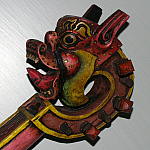
with often deep blue for the inside of the neck and for the horsehead.
|
|||||||||||||
| top | Nepal | |||||||||||||
|
tungana
In the mountain valleys of Nepal a small plucked instrument is played, that is sometimes (on old LP's) called a dramyen. However, this is in fact the name used for the much bigger Tibetan lute, which is quite different anyway (see under). The Nepalese name of this Nepali lute is tungana (or tungna). They come in different models and sizes, and sometimes are almost as big as the dramyen. See also Bhutan, furtheron. The body, neck and pegbox are all carved from one piece of wood. Body and neck are hollowed out from the front. The bottom half of the figure-of-eight body is covered with some thick skin, and the top half and neck with thin wood, fitted within a rim. There is one small soundhole on the back. The back of the body is full of woodcarvings in Buddhist style. Also the "fingerboard" has woodcarving, but in such a way that it is not easy to finger the strings. The neck is fretless.
Playing is mostly done by strumming to accompany singing. For more information about this type of instrument see : ArtsPremiers (in French). See also the tungana mentioned under Bhutan. As the tungana is small and solid it is easy to carry about. In Kathmandu they are sold as souvenirs (more for the woodcarving than for their musical qualities). As the houses in Nepal are always full of smoke, the instruments are usually quite smelly and greasy. |
|||||||||||||
|
arbajo In the west of Nepal (mainly the districts Lamjung and Kaski) an instrument is used, called arbajo (or aarbajo or arbaj or arbaja). It is mainly played by the Gaine caste and sometimes called "bhale sarangi" ["male sarangi" (a kind of folk fiddle)]. It is almost extinct, although some populair singers try to re-introduce it again. There is a variety in models and sizes.
The pegbox on some arbajo is sickle-shaped and
turns sharp to the back with some simple woodcarving. On others it is
straight with a woodcarving of a bird. Playing the arbajo is mostly done by strumming simple "chords" to accompany singing, usually by the player himself. |
|||||||||||||
| top | Tibet | |||||||||||||
|
dramyen
In spite of the many instruments sold on eBay
called "Tibetan", these are really all basically Chinese instruments
- although painted in some typical way. The body and beginning of the neck are carved from one piece of wood and hollowed out. The bottom half (which is round) is covered with thick skin - probably goatskin (sometimes painted green); the Chinese zhamunie usually has snake skin. The top half of the body extends at both sides of the neck to a rather sharp point, over the entire depth of the body - not just a shallow extension like on the Kashgar rababs. This half is covered with thin wood, as part of the fingerboard.
The 6 silk (or nylon) strings (in 3 courses) run over a loose wooden bridge to a wooden extension on the end of the body. A plastic plectrum is tied with rope to this extension. Tuning would be something like : aa dd gg. Playing the dramyen is with a plectrum (fixed on a rope) picking simple "riffs" to accompany usually quite jolly singing. All playing is done in the first position.
This example instrument I bought from a group of musicians in Lhasa (playing near the Winterpalace of the Dalai Lama) and so is extra decorated: red paint all over, with blue edges; flower-like decorations and even a horse head carving on the pegbox. Even the silk strings are coloured : with accent pens in yellow and pink ! |
|||||||||||||
| top | Bhutan | |||||||||||||
|
dranyen
In Bhutan (the mountainous country to the East of
Nepal and Sikkim) they play a similar looking dramyen as in
Tibet and Ladakh. It is sometimes spelt as dramnyen.
The extra 7th string comes from a peg halfway the neck, on the left side, but is in fact the 5th string on the bridge, and part of the second course. The strings run over a loose wooden bridge on the skin to a wooden extension at the edge of the body. Tuning of the nylon strings could be : aa (d)dd gg. There is often a lot of painted decoration on all sides of the instrument, based on traditional Bhutanese symbols. Playing the dranyen is with a plectrum (fixed to a rope) short limited riffs in first position, to accompany singing. |
|||||||||||||
| top | ||||||||||||||
|
tungana Bhutan employs lots of Nepalees workers, who have brought their own plucked instrument, the tungana (or tungna). They come in different sizes, and sometimes are almost as big as the dranyen. Maybe because of the influenze of the colourful Bhutan dranyen, you can find in Bhutan the more colourful tunganas. Basically they are the same as the ones in Nepal. The body, neck and pegbox are all carved from one piece
of wood. The body is hollowed out with two separate round cavities.
The bottom half of the figure-of-8 body is covered with some thick skin;
the top half and the fingerboard with a piece of thin wood, with a raised
rim around it. It also has a carved rosette as soundhole.
Playing the tungana is mostly done by strumming, to accompany singing and dancing. For more information about this type of instrument see : ArtsPremiers (in French). |
|||||||||||||
|