•
HOME
• about
• collection
• books
• index
• links
• lutes
• guitars
early
• guitars
modern
• mandolins
• cittern
• banjos
• steelguitars
•
miscellaneous
•
Europe West
• Europe East
• Europe South
• Africa
•
Middle East
•
Central Asia
• India
•
Far East
•
S.E. Asia
•
America N
•
America C
•
America S |
This
page is only for those of you interested
in my personal history of music and travelling
THE
HISTORY OF MY INSTRUMENT COLLECTION
I am a Dutchman and live in a beautiful old town in the centre
of the Netherlands.
My collection of plucked stringed instruments started already more
than 50 years ago, when in 1966 (with my younger brother) I made
a simple guitar out of wood and card board. A few months later I
bought my first (cheap Spanish) guitar, and learned to play the
instrument from a teach-yourself course. |
 |
A year later I started a group with some friends.
This band, called SUNNY SIDE, lasted about 7 years. We played
all kinds of music, but in the end mainly Country and Western.
As I was the leadguitar player, and - for some reason - the
others did not allow me to sing, I concentrated on the instruments.
|
To get a variety of different C&W sounds I started playing
5-string banjo, (lap) steel guitar, mandolin and
in the end also pedal-steelguitar. As there was nobody
around to teach me, I had to learn all these instruments from
just a few books, but mainly from listening to records. With SUNNYSIDE
we played quite regularly: about 30-40 times a year. Often as
a band for dance music, but also several times for live recordings
for Dutch radio, usually with presentor Gerard de Vries in his
"TrossCountryShow". Although we also recorded some songs
in a studio, only a few were actually released. In 1972 we were
invited for a TV show, which was recorded in the studio and broadcast
a year later. |
| In
1976, after a break of a year (for me to go on an exciting world
trip, from Europe up and down to Australia, both ways overland),
I joined another Dutch group : COLT 45. They had just made a
LP record and been on a tour to Nashville, USA. |
 |
|
I played with them until they gave up 2 years later. With
them I mainly played the leadguitar and the pedalsteelguitar.
COLT45 was voted 2nd best C&W band in Holland for several
years. Quite often we played for live concerts on Dutch radio,
and made several recordings, none of which was ever released.
For a few months two sister singers joined us - after they left
they became later known as duo "Maywood". After the
breakup of the band I was sometimes invited to join some other
group when they had some important show or radio recording. In
1978 I stopped altogether with playing in bands. |
 |
I started playing at
home on my own again, mainly classical guitar music. Part of that
is from the huge reservoir of lute music of the 16th and 17th century.
That raised an interest in playing that kind of music on "authentic"
instruments (from original tablature sheet music), and as you could
not buy those in a normal music shop, I had several instruments
custom built. Many came from makers in the UK. |
|
Starting with a renaissance
lute, then an orpharion, a liuto attiorbato,
a vihuela, a baroque guitar, etc. When I joined
the new Dutch Lute Society (Nederlandse Luitvereniging), I certainly
was the only member who was also a member of the Dutch Pedalsteelguitar
Association ! Many years later I had some more "old"
instruments built for me in the Netherlands. Some were first designed
by me in close colaboration with the maker, before they were actually
built - like the chitarra battente and the citole. |
Meanwhile from my worldwide (tourist) travels (now with my UK
wife) I started bringing home small instruments, like charangos
from Peru. Over the years the instruments became larger and
we carried them home in ever greater numbers. |
 |
| The main
interest was plucked stringed instruments, like guitars
and lutes (not really harps or zithers). Any special
local instrument would be of interest. And not a fancy decorated
one, but usually a cheap plain version, that would be in general
use. Sometimes it was a problem to find the particular instrument
from that region in the short shopping time available. So often
the first thing on arrival was to start searching. This resulted
in some instruments being bought only a couple of hours after
landing; and that meant they had to travel all around the country
with us. Fortunately we never damaged any instrument on our
trips. Good hunts were Pakistan (see picture), Turkey, Peru,
Mali and Indonesia. |
 |
On our travels I always carried a small (cassette) recorder
with me. Originally intended to make recordings of music that
we would encounter on the way. But besides many folk songs and
instruments (on the picture a fiddle player in Tanzania), I also
recorded many other very interesting sound samples. |
| Like the chanting of Buddhist monks in Tibet, the morning calls
of the Indris (lemurs) in Madagascar, tree-frogs in Costa Rica,
Gregorian songs in an Armenian church, mewing frogs in the Pantanal
in Brazil, the echo of a single handclap inside the Taj Mahal (India),
a similar echo inside the big mosque of Isfahan (Iran), howling
lions in the Serengetti (Tanzania), markets in the Middle East,
etc. And of course a huge variety of birdsongs - from buzzards and
woodpeckers to toucans and macaws. |
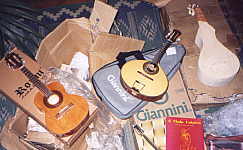 For the last couple of years with Internet (and specially with
eBay), searching for new instruments is different, and in many
ways certainly much easier. Although it means paying a lot for
the shipping cost. However I found out that it is not really
necessary to ship by expensive couriers like UPS or FedEx; the
normal airmail postman is often just as good for a fraction
of the price. It is quite fun finding a selling person halfway
the globe and have a friendly contact with him/her via email
to work out the details of the deal. And in the end to recieve
big parcels from Iran, Venezuela, Brazil, Bolivia, Borneo, China,
Vietnam, Japan, Turkmenistan, Uzbekistan, Canada or USA. In
fact my main supplier is a friendly guy in a shop in São
Paulo in Brazil, who sold me five different instruments....
For the last couple of years with Internet (and specially with
eBay), searching for new instruments is different, and in many
ways certainly much easier. Although it means paying a lot for
the shipping cost. However I found out that it is not really
necessary to ship by expensive couriers like UPS or FedEx; the
normal airmail postman is often just as good for a fraction
of the price. It is quite fun finding a selling person halfway
the globe and have a friendly contact with him/her via email
to work out the details of the deal. And in the end to recieve
big parcels from Iran, Venezuela, Brazil, Bolivia, Borneo, China,
Vietnam, Japan, Turkmenistan, Uzbekistan, Canada or USA. In
fact my main supplier is a friendly guy in a shop in São
Paulo in Brazil, who sold me five different instruments....
|
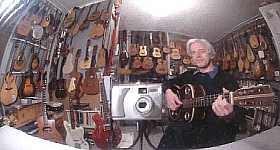 |
All instruments were put
together in one room, almost all of them hanging side by side, with
the face front, so you could have a proper look at them (I did not
like the idea of a storage room). However, the open spaces between
the instruments were becoming very small, so now I am using a second
room, with special guitar racks to stand the guitars sideways -
safe and compact, but unfortunately you can now only see the sides.
I do not use special temperature or moisturing devices, just keep
the central heating down - which means the rooms are quite cold
in winter. The only damage I have had in al those years is a broken
skin of my shamisen (later repaired in Japan) and the front
coming loose from my orpharion (I repaired it with advice
from the maker). Both happened during hot dry summers, while we
were on holiday. |
 |
 |
The collection also
includes any book I can find on the subject of guitars, banjos,
ethnic instruments and music - no matter what language (although
working out Chinese characters takes up lots of time...). I have
now more than 500 books about musical instruments.
Of course I am also trying to have at least one music example
of each instrument on numerous CD's, LP's, and cassettes. Keeping
an eye open during my travels and nowadays checking out far away
book- and music shops on Internet is a great help.
As the instrument collection is not intended for
just the beauty of the woodwork (as are many museum collections)
but to show playable musical instruments, I always try to find
out the tuning and buy some sheetmusic with "how-to-play-it".
Almost all instruments are in playing condition and I can let
you hear more or less how they should sound.
As the Collection cannot be visited, I intent to
use the collective gathered information of the Collection as basis
for a book about all plucked stringed instruments of the world
(like a bird-book) : with a picture and a description and some
background information about playing techniques and type of music.
But that book will have to wait a few more years, until after
I retire....
So for the time being here is this ATLAS website for you to
use, for checking out some strange looking instruments.
I hope you enjoy it !
Henny de Bruin
|
|


